Why a Threshold Changes the Welcome
A threshold changes the welcome by shaping arrival, greeting, and invitation; learn how to notice those cues without assuming every household uses them alike.
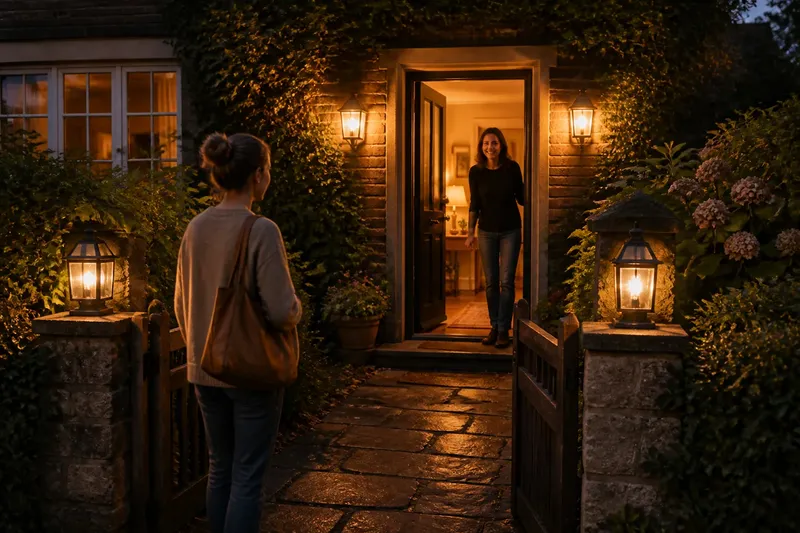
A threshold changes the welcome by turning arrival into a small sequence: someone approaches, a greeting passes between people, and an invitation signals what happens next. At a front door, garden gate, apartment entry, or porch, these cues help visitors understand whether to wait, step closer, or come inside.
That sequence is not a universal script. A host’s habits, the layout of a home, local customs, and the reason for a visit all shape what counts as polite. Paying attention to the order of events is more useful than treating one familiar greeting as a rule for everyone.
What does the threshold signal?
A threshold marks a change in access. It may be a literal doorway, but the social boundary can begin earlier: at a gate, along a shared path, or where a host comes out to meet a guest. The boundary tells visitors that they are approaching someone else’s space, not yet that they have permission to enter it.
Watch for what the host does before crossing that boundary. They may open the door and stay there, step onto the porch, gesture toward an entryway, or continue a conversation from the doorway. Each action offers information, but its meaning depends on the people involved. An open door, for instance, may simply help the host speak to someone outside.
Think of a threshold like the edge of a rug: it marks a transition without explaining every rule on the other side. Visitors can pause long enough to see whether the host closes the distance or makes a clear invitation. That brief pause gives both people room to coordinate.
How should a guest arrive?
Arrive in a way that gives the host a chance to notice you and respond. At a house, use the expected entrance rather than treating an unlocked gate or open doorway as an invitation to walk in. In an apartment building or shared residence, follow the arrangement the host gave you, such as calling from the lobby or waiting at the unit door.
Once someone answers, offer a greeting that fits the relationship and the setting. A familiar host may welcome a wave or an informal hello; a first visit may call for a name and a short introduction. If you are unsure whether to remove shoes, carry an item farther inside, or greet everyone at once, wait for a cue or ask plainly.
Say you arrive at a friend’s townhouse for a meal and hear conversation from inside, but nobody has opened the door. You ring once and wait; when your friend appears, you greet them and hold back while they gesture toward the entry. The visible result is a clear handoff: your friend has a moment to meet you, and you have a signal before entering.
When is an invitation clear?
An invitation is clearest when words or gestures specify the next action: “Come in,” a hand motion toward the hall, or an offer to meet you at the gate. A greeting alone acknowledges your arrival but does not always answer whether to cross the threshold. Keep those two acts distinct in your reading.
Some hosts expect guests to enter after a familiar exchange; others prefer to invite each person explicitly. A host may also be occupied, so a delay can mean they are finishing a task rather than refusing entry. Stay where you were asked to wait, and make it easy for the host to direct you without raising your voice or pressing forward.
When the cue remains unclear, a brief question is courteous: “Would you like me to come in?” That gives the host a simple choice and avoids turning a guess into an awkward correction. If the host says to wait, take the answer at face value.
Why do customs differ?
Households differ in how they manage privacy, time, and familiarity. A rural home with a long approach may use a porch greeting; a city apartment may rely on an intercom and a secured entry. Family members, neighbors, invited guests, and service visitors may also follow different routines at the same address.
Regional habits matter, but they do not determine every individual’s preference. People may greet with a handshake, a hug, a nod, or words alone; some invite guests straight inside, while others pause to exchange news at the door. Treat what you observe as guidance for that encounter, not evidence that everyone in a place behaves alike.
Practical needs can change the sequence too. A host carrying groceries may ask you to wait while they set things down, and a household with a sleeping child may keep greetings quiet. An accessible route or a weather shelter can shift where the greeting happens. Respecting the stated arrangement matters more than trying to identify a regional rule.
What cues should you notice?
Look at the complete exchange rather than one gesture. Notice where the host meets you, whether they step aside, what they say, and whether they indicate a place to go. The combination usually gives a better reading than an open door, smile, or wave on its own.
- Location: Does the host meet you at a gate, doorway, lobby, or another agreed point?
- Words: Is there a greeting only, or a direct invitation to enter?
- Gesture: Does the host point or move toward a place, or remain at the threshold?
- Timing: Are they ready to receive you, or asking for a moment?
- Follow-up: After you enter, do they direct you to a room, a seat, or a place to leave your coat?
These are observations, not a code to decode mechanically. If several cues conflict, use the host’s spoken direction and ask a simple question rather than assigning a fixed meaning to a smile or gesture.
What questions help guests?
Should I wait at the door?
Wait when the host has not invited you across or when the agreed meeting point is outside. A brief pause lets the host set the pace and gives you a chance to hear any practical direction.
Is an open door an invitation?
Not by itself; a door may be open for ventilation, conversation, or convenience. Look for a spoken invitation or a gesture that clearly directs you inside.
What if I arrive early?
Follow the timing the host gave you, and contact them if your arrival creates uncertainty. Avoid entering or waiting somewhere private unless they have asked you to do so.
How can I avoid assuming a custom?
Notice what this host does, then ask when you cannot tell what they prefer. One household’s routine can guide your next visit there, but it should not become a rule you apply to every home.
How can hosts make arrival easier?
A host can make the sequence legible with a short message before the visit: name the entrance, say where to wait, and explain how to signal arrival. At the door, greet the visitor and give a direct next cue, such as asking them to come in or to wait while you finish a task. Specific language is kinder than expecting a guest to infer permission from the setting.
For gatherings, a visible person near the entrance can help newcomers understand where to go without making the doorway a bottleneck. If several people arrive together, greet them in turn and indicate whether they should enter, stay on the porch, or move to a shared room. A little clarity preserves the human part of the welcome: attention, recognition, and a choice about crossing into someone else’s space.
To understand why a threshold changes the welcome, follow the sequence in front of you: arrival, greeting, and invitation. The most considerate response is not to assume that a familiar doorway means a familiar custom, but to notice the host’s cues and leave room for a clear answer.