The Shared Table Before the Dining Room
The shared table is a social arrangement, not a room style. Learn how different table settings bring people together and choose one for your household.
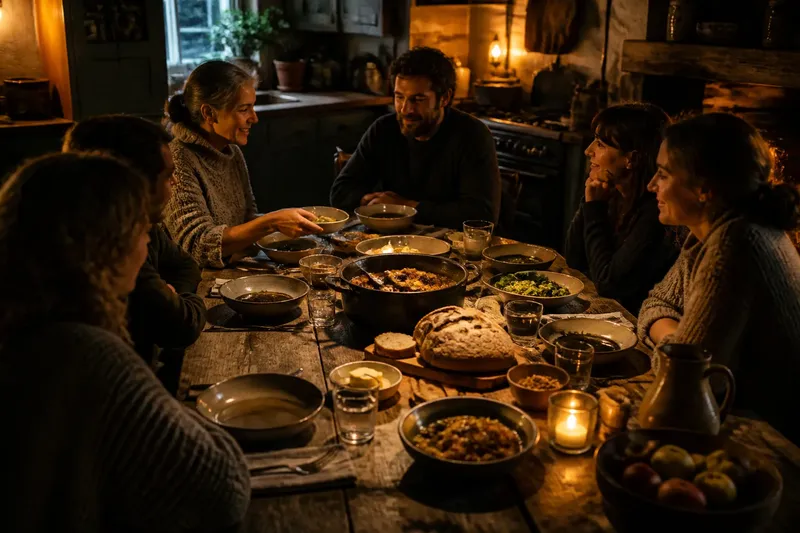
The shared table is a social arrangement, not a dining-room style. A kitchen table, a bench beside a hearth, or a board set across trestles can all serve as a shared table when people gather around food and make room for one another. The distinction matters: the room may be formal, but the table’s social role comes from how it is used.
Company before interiors
Eating together does not require a dedicated room. People have gathered around whatever surface, furniture, or open space could hold a meal. The essential arrangement is a common center: food can be passed, conversation can travel, and each person can see or hear the others.
A dining room adds boundaries and expectations. Its furniture, lighting, and placement may mark a meal as a special occasion, while a table in a kitchen often accommodates ordinary tasks alongside eating. Neither arrangement determines whether people feel included. A formal room can host relaxed company; a crowded kitchen can leave someone awkwardly outside the conversation.
Think of the table as a lamp shared by a room: its purpose is not the shape of the room around it, but the way it gathers attention. That simple distinction helps explain why the shared table can appear in many domestic settings without belonging to any single style.
Three social arrangements
Different table arrangements support different kinds of company. These are not stages of progress, and households can move between them as the occasion and available space change.
The everyday kitchen table
A kitchen table sits close to food preparation and household routines. It suits people who want meals to fit into daily life, including households where cooking, homework, correspondence, or conversation share the same surface. Its familiar setting can make an informal invitation feel easy to accept.
The trade-off is that domestic work may remain visible. A stack of mail or a mixing bowl can interrupt the meal unless someone clears a place. That need not be a problem; it simply means the table’s welcome is often practical rather than ceremonial.
The long communal table
A long table creates a clear gathering place for a larger group. It suits reunions, shared dishes, and occasions when people are comfortable serving themselves or passing food along. A plank supported by trestles or several tables arranged end to end can create this effect without a formal dining suite.
Its length can also separate people at opposite ends. Guests may settle into smaller conversations, and passing a dish may become awkward if the setting is crowded. A long table works best when the meal and the group can use its length, rather than when every guest is expected to speak to everyone at once.
The small round table
A round table brings a modest group into a more even circle, with no obvious head position. It suits a few people sharing a meal or a conversation that should feel open and balanced. Since there are no corners, movement around it can also feel less formal in a compact room.
Its limited surface can make serving several dishes difficult, and chairs may crowd one another. For a small meal with food placed within easy reach, the close arrangement can be welcoming; for a spread that needs room, it may feel cramped.
Food shapes the gathering
The way a meal is served changes what people do at the table. Shared platters invite passing, negotiation, and attention to others. Individual plates can make serving more orderly and give each guest a clear portion, while a pot or bowl placed in the center can become a natural point of conversation.
These choices do not carry a single meaning in every household or region. A dish passed from hand to hand may express generosity in one setting and simply be the practical way to serve supper in another. The useful question is what the arrangement asks guests to do: wait, reach, serve themselves, or rely on a host.
Say you are hosting a few neighbors in a kitchen where the table is narrow. You could place a pot of stew and bread within reach, then serve a side dish from the counter as needed. Guests would have a shared focus without needing a larger table or a separate dining room.
Choosing a table setting?
Does a shared table need a dining room?
No. It needs a usable place for people to gather around food, not a room reserved for dining. A kitchen, porch, or multipurpose room can serve the same social purpose if guests can sit and share the meal comfortably.
Is a formal dining room less communal?
Not by itself. A formal room can encourage a shared meal when the host makes conversation and food easy to reach, while an informal space can still feel divided if people cannot see or hear one another.
Which arrangement suits a large group?
A long communal table can make room for many guests, especially when dishes are passed along or served from a central area. If the group includes people who would struggle to reach across it, separate smaller tables may make the meal more comfortable.
How can I choose without a dedicated dining room?
Start with the space available, the number of guests, and how the food will be served. Choose the arrangement that lets people sit securely, reach what they need, and take part without making the room’s original purpose a barrier.
A clear way to choose
Begin with the gathering rather than with a room category. Ask how many people will come, whether food will be passed or served individually, and whether the table must also support household tasks before or after the meal.
- Choose an everyday kitchen table when meals are frequent, informal, and connected to cooking.
- Choose a long communal arrangement when a larger group will share dishes and can use the full length.
- Choose a small round table when a few people need a close, balanced setting.
- Use separate tables when one surface would make serving or conversation difficult.
- Keep the food arrangement simple enough that guests can participate without waiting for constant help.
Then consider the room’s practical limits. A table should leave people a comfortable route to their seats and allow food to reach the group. If furniture cannot move, a serving tray or a dish placed on a nearby counter can extend the gathering without pretending the room is something else.
Room and ritual
A dining room can give a meal a distinct setting, but it does not create the shared table on its own. That role comes from a pattern of gathering: people sit near enough to share food, respond to one another, and recognize the meal as something held in common.
For a reader deciding what arrangement to use, the shared table is the more useful idea than the dining room. Look at the meal, the group, and the available space; then choose the setting that lets those people share the food with ease. A separate room may enrich the occasion, but the table’s social purpose can begin wherever people make room for one another.