Hand-Thrown or Moulded: Reading a Ceramic Bowl
Learn how to read a hand-thrown or moulded ceramic bowl through rim, foot, and surface clues, while avoiding claims appearance alone cannot support.
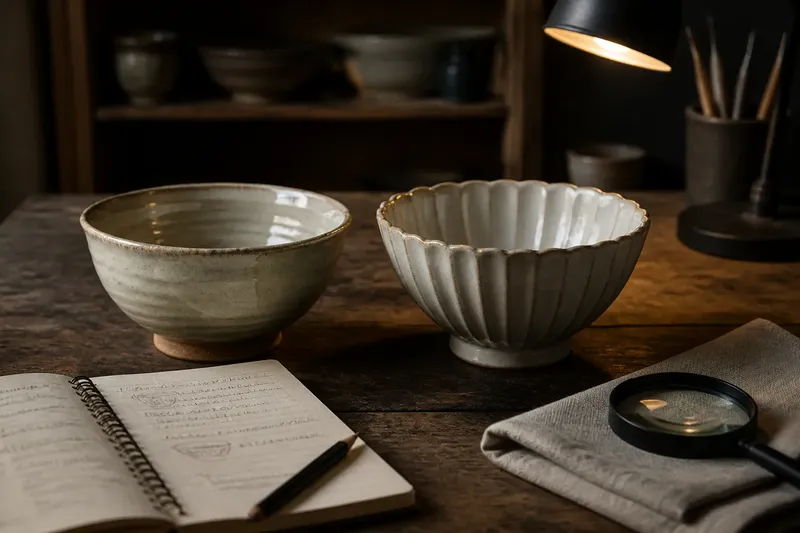
A hand-thrown or moulded ceramic bowl often reveals its making in the rim, foot, and repeated surface details, but no single mark proves its origin. To read a hand-thrown or moulded ceramic bowl carefully, compare several clues and separate what you can observe from what you can only infer.
A week of looking
Give the bowl a week of short, deliberate attention rather than trying to identify it at a glance. This routine is for looking, not handling a fragile or unstable piece; keep it on a steady surface and use soft, indirect light. A phone camera can help you compare views, but avoid flash if glare hides the surface.
On the first day, record the bowl’s visible features without naming its production method. Note the profile, rim shape, foot, glaze, color, and any repeated marks. A plain description such as “the rim varies slightly in height” is more useful than “definitely handmade,” because the first is observable and the second is a claim.
On the next day, look at the bowl from above and from the side. If practical, turn it only when you can do so safely, supporting the body rather than lifting by the rim. A shallow, regular curve can occur in either kind of bowl; the question is whether small variations recur in a way that suggests shaping by hand or arise from a mould’s repeated form.
Rim and profile
A potter forming a bowl on a wheel centers clay and raises its walls as the wheel turns. The result may show subtle differences in wall thickness, curvature, or rim height. These are clues, not requirements: a skilled maker can produce a very regular silhouette, and later trimming or finishing can soften visible irregularities.
A moulded bowl takes its basic shape from a form, often with clay pressed or cast into it. Its outline may repeat with notable consistency across examples, and details such as a fluted edge can appear evenly spaced. Yet a moulded piece can still have hand-finished edges, while a thrown bowl may be altered with tools or additions.
On the third day, trace the profile visually rather than relying on touch. Compare opposite sides and note whether the curve changes gradually or includes a repeated ridge, panel, or indentation. A single wavering line might come from a finishing choice, use, or damage; it is not enough to settle the question.
Wheel and mould marks
On the fourth day, inspect the interior under a soft light. Concentric lines or shallow grooves can appear where a tool shaped the clay on a turning wheel. They may support a wheel-thrown interpretation, but throwing marks can be smoothed away, and circular traces can also result from later finishing.
Look for seams, joins, or repeating design elements as well. A faint line along a side or base may be associated with mould construction, particularly if it aligns with a repeated feature. But seams can be removed, and a mark may come from trimming, decoration, or repair. Record its location and shape instead of assigning a cause too quickly.
On the fifth day, compare the bowl with another object only if you have a reliable basis for comparison, such as a matching piece from the same set. Similarity in shape and decoration may point to repeated production, but it does not identify the exact process. A matching pair is evidence of consistency, not a certificate of moulding.
The foot and underside
The foot is the ring or base that supports many bowls. On the sixth day, examine it without scraping or rubbing. A trimmed foot may show tool marks or a rougher clay surface where glaze does not cover it. Those details can help describe how the bowl was finished, but they do not by themselves distinguish wheel throwing from moulding.
Check whether the foot is centered beneath the body, whether its edge is even, and whether glaze pools or stops at a consistent boundary. A foot can be added or altered after the main form is made, so it may tell you about a stage of production rather than the whole method. The underside is one part of the object’s making, not a verdict on its origin.
Imagine you are comparing two bowls with similar glazed interiors. One has slight changes in rim height and faint circular lines inside; the other has evenly repeated fluting and a barely visible seam beneath the glaze. You could describe the first as showing clues consistent with wheel shaping and the second as having features consistent with moulding, while leaving both identifications open.
What can appearance tell you?
Does an uneven rim prove hand throwing?
No. A rim can become uneven through hand finishing, wear, or damage, and a thrown bowl can be finished to a highly regular outline. Treat variation as one clue among several, and note whether it appears intentional, repeated, or accidental.
Do concentric lines prove a bowl was wheel-thrown?
They suggest a turning action may have shaped or finished the surface, but they do not establish the full production method. A moulded or cast form may receive later turning or trimming, and a thrown interior may be smoothed until its lines are hard to see.
Can a visible seam identify a moulded bowl?
A seam can be consistent with moulding, especially when its position corresponds with the design or a repeated form. It is not conclusive on its own because seams may be hidden, removed, or created during another part of manufacture.
What should I say if the method is uncertain?
Describe the evidence directly: “The bowl has a regular profile and a faint line beneath the base.” If useful, add a qualified interpretation such as “These features may be consistent with moulding,” rather than presenting an appearance-based guess as fact.
Keep the record honest
On the seventh day, review your notes and group them into three categories: observed features, possible interpretations, and unanswered questions. That simple separation works like sorting kitchen utensils into drawers: it keeps different kinds of information from getting mixed together.
For example, “evenly spaced ridges” belongs under observation; “possibly formed in a mould” belongs under interpretation. A maker’s mark, seller’s description, or documented provenance may add context, but each source should be identified as such rather than merged with what the bowl itself visibly shows.
When labels, maker information, or care instructions are available, their wording can clarify the object’s description and handling; follow any care directions provided for that bowl. For an unmarked piece, uncertainty is not a failure of observation. It is a fair account of what appearance can and cannot establish.
By the end of the week, you should have a more precise description, not necessarily a final answer. When writing about a hand-thrown or moulded ceramic bowl, the most useful conclusion names the visible clues and states how strongly they support an interpretation. That careful distinction lets the object remain interesting without asking its surface to tell a story it cannot prove.