The Heirloom Rule: Must an Old Object Stay as It Was?
The heirloom rule need not mean leaving an object untouched; weigh its use, memory, condition, and your own wishes before deciding what comes next.
The heirloom rule often sounds simple: keep the old object exactly as it is. But an heirloom can remain meaningful while being used, repaired, or changed, and the right choice depends on what the object means to you—not on age alone.
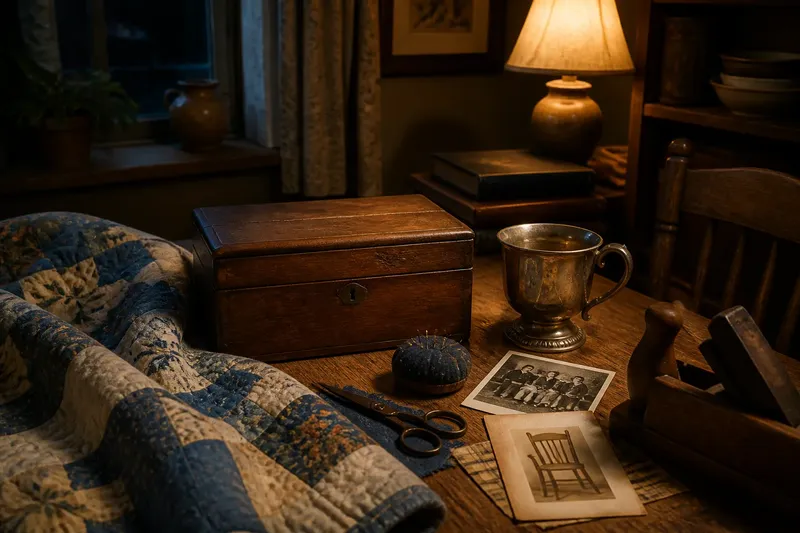
A blue quilt may be brought out on cold evenings, while a silver cup stays in a cabinet because its handle is loose. Neither choice makes the object more or less of an heirloom. The useful question is what kind of relationship you want to have with it, and what each option asks you to give up.
What Makes an Heirloom
An heirloom is an object carried across generations, usually with a story attached. It might be a hand-stitched quilt, a carpenter’s plane, a wedding ring, or a recipe box. Its value may come from workmanship, family association, continued use, or the fact that someone chose to pass it on.
Those sources of meaning do not always point in the same direction. A cast-iron skillet may matter because a relative cooked with it, but frequent cooking can alter its surface. A wooden tool might be important as a surviving example of a craft as well as a practical object. Calling something an heirloom does not decide which quality should take priority.
It helps to separate preservation from continuity. Preservation aims to retain an object’s existing condition. Continuity means keeping its place in a family or household, even if it serves a new purpose or receives careful repairs. These aims can overlap, but they are not identical.
Use and Wear
Using an object can keep its purpose and associations alive. A quilt over a bed, a bowl on a kitchen shelf, or a hand tool in a workshop can become part of ordinary life rather than a relic viewed only on special occasions. Use also brings contact, wear, and the possibility of accidental damage.
Leaving an object untouched has its own costs. A fragile textile stored poorly may deteriorate; a tool that no one knows how to maintain may become unusable. On the other hand, constant handling can be hard on a delicate photograph or a garment with weak seams. The aim need not be to choose between “use it” and “save it.” You can change how, where, or how often it is used.
Think of an heirloom like a familiar wooden chair: keeping it in service may mean tightening a joint or replacing a worn seat, while leaving it untouched may preserve its current appearance. The repair does not erase the chair’s history, but it does add a new layer. Whether that addition feels welcome is a personal judgment.
Memory Without a Rule
Family stories can make an object feel as if it comes with instructions: never wear the brooch, never repaint the chest, never serve food in the platter. Sometimes those requests reflect a clear wish from the person who passed it on. Sometimes they are habits repeated without anyone remembering why.
Ask what you know, and distinguish it from what you assume. If a relative said the quilt was meant to be used, that is different from a general belief that family quilts always belong on beds. If no preference was expressed, you do not have to invent one on the former owner’s behalf. You can honor the person without treating every inherited object as a command.
Say you have a wooden sewing box from an aunt, with a cracked lid and no written instructions. You might decide to keep it closed and display it as it is, or have a furniture conservator assess whether the lid can be stabilized so the box can hold sewing supplies again. In either case, you could write down what you remember about your aunt’s sewing habits and keep that note with the box. The object and its story would remain connected, though you would have chosen different ways to care for them.
Change With Intention
Not every change is irreversible. Cleaning, mending, adapting, and repurposing sit on a spectrum, and some choices are easier to undo than others. A storage box can be moved to a safer place; a cut-down garment cannot simply be restored to its former shape.
Before making a change, ask yourself:
- What matters most here? Name the feature or association you most want to retain.
- What is the object’s condition? Look for loose joints, fading, cracks, weak fabric, or signs of previous repair.
- How would I use it? Consider the setting and handling it would receive in ordinary life.
- Can I choose a reversible option? Prefer a temporary display, protective cover, or separate storage when it meets your needs.
- Who else has a meaningful connection to it? A brief conversation may reveal family knowledge or expectations you had not heard.
For delicate, valuable, or uncertain materials, ask a qualified conservator before cleaning, repairing, or altering the object. For everyday items, follow the maker’s care guidance if available; materials and construction can call for different treatment.
Questions About Heirlooms?
Does using an heirloom disrespect its history?
Not necessarily. Use can continue an object’s original purpose and keep it present in daily life. The question is whether the expected wear feels acceptable to you and to anyone with a strong shared claim on it.
Should I restore an heirloom?
Restoration may make an object more stable or usable, but it can also change its appearance and remove evidence of age. Decide what you hope to gain, then ask a qualified conservator about options when the object is fragile or the work could be difficult to reverse.
What if relatives disagree?
Start by separating ownership, practical care, and emotional attachment; they may not belong to the same person. A calm conversation about what each person wants preserved can reveal a solution such as shared use, a temporary loan, or a record of the object’s story.
Can I pass an heirloom on differently?
Yes. You might give it to someone who will use it, keep it in a shared household, or pass along its story without requiring a particular display or ritual. Clear, modest instructions can help the next person understand your wishes without making the object a burden.
A Personal Inheritance
There is no universal test for whether an heirloom has been kept properly. One person may treasure the scuffs on a workbench; another may prefer to stabilize it before further use. Both choices can come from care, provided they reflect thought rather than an unexamined rule.
The heirloom rule is most useful when treated as a question, not an obligation: what should continue, and what may change? If you can answer that in your own terms, you can make room for the object’s past without surrendering your choice about its future. A short note with the object—what you know, what you changed, and why—can make that choice legible to the next person who holds it.