A First Visit to a Community Craft Fair
A first visit to a community craft fair can feel relaxed and rewarding: learn what to notice, how to ask makers considerate questions, and when to pause.
A first visit to a community craft fair is easier when you treat it as a place to look before it is a place to shop. Start by noticing how objects are made, ask a maker only when the moment feels open, and leave room to wander without a purchase in mind. You do not need craft vocabulary or a plan to buy; attention is enough to begin.
Before You Arrive
Check the fair’s public information for its location, opening hours, accessibility details, and any guidance about food, pets, photography, or entry. Community fairs may take place in a school gym, a town hall, a church basement, or an outdoor market, and the setting can affect how you move through it. If you are unsure about an access need or a venue rule, contact the organizer in advance.
Decide what would make the visit comfortable. You might choose a loose time window, bring a small bag for a coat or water bottle, or agree with a companion to meet near the entrance if either of you wants to browse alone. These are conveniences, not obligations; there is no correct way to cover every table.
It can help to pick one thing to notice rather than a shopping target. Look for how color is used, what different materials feel like to the eye, or how makers display objects that serve similar purposes. A modest focus gives your attention somewhere to land without turning the fair into a task.
Enter at an Easy Pace
Once inside, take a moment to get your bearings. Notice where the aisles begin and end, where people are pausing, and whether there is a printed map or list of exhibitors. If the room is busy, step aside before checking your phone or studying the layout so other visitors can pass.
Then begin with a slow pass through the stalls. You can look broadly before stopping: ceramics, textiles, woodwork, prints, jewelry, and other work may be arranged by maker rather than by material. A fair can feel like a shelf of different stories; there is no need to read every spine before choosing where to pause.
Keep your hands to yourself unless a maker invites you to handle an object or a sign says samples are available. This is especially considerate around delicate pieces, food, and displays where items are close together. If you would like a closer look, ask first rather than reaching across the table.
Notice the Materials
Materials offer a useful starting point because you can observe them without knowing technical terms. Look at the surface, edges, joins, and changes in texture. A woven cloth may show a pattern more clearly at its border; a wooden object may reveal grain along an edge; a metal piece may combine a polished area with a deliberately rough one.
Notice how the material and the object seem to work together. A sturdy handle may be shaped for frequent use, while a thin, translucent panel may invite light through it. These observations are not judgments about quality. They are ways to understand what choices you can see and what you might want to ask.
Use plain language if a material is unfamiliar. “What is this made from?” is a complete question. You can also ask whether a color is part of the material or applied to its surface, or whether two similar-looking pieces differ in how they are made. A maker can supply the terms if they are useful.
Move Through the Stalls
Let the room set your pace. A quick glance at a crowded table may be enough for now; you can return if the aisle clears. At a quieter stall, give yourself time to notice details before starting a conversation. Looking without speaking is normal, and a maker who is busy serving another visitor may appreciate the space.
Pay attention to the signs as well as the objects. A small card may name a material, explain a process, or identify a piece as made to order. Reading it can answer a question without interrupting the maker, and it may help you decide whether you want to ask anything further.
If you are with someone, share what caught your eye without treating your preferences as a verdict. “I like the uneven blue line” invites a conversation; “this is better than the next table” turns browsing into a ranking. The fair is a meeting place for different kinds of work, not a contest you need to score.
Ask Considerate Questions
Before speaking, look for a natural opening: the maker is not in the middle of a transaction, their attention is available, and you are not blocking the table. A brief greeting gives them a chance to engage or continue working. If they are occupied, read the display or move on and return later if you wish.
Questions about visible choices are usually easy to answer and specific to the work in front of you. You might ask what material a piece uses, how a maker chose its shape, or what changes between two versions. A question that starts with what you can see shows interest without asking for a long account of someone’s entire practice.
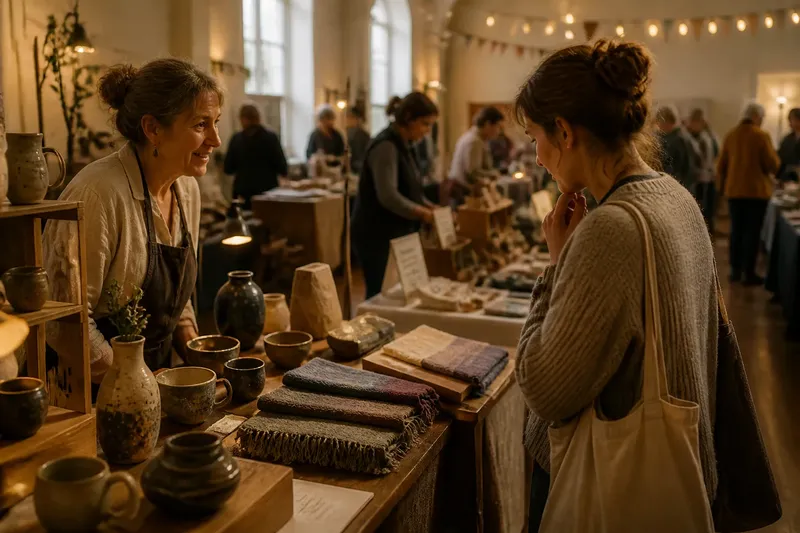
Say you stop at a table of handwoven scarves and notice that one edge is denser than the rest. You might ask, “Does the border help the scarf hold its shape?” If the maker says it is mainly decorative, you have learned something about that piece; if they are busy, you can thank them and continue browsing.
Respect a short answer. The maker may be concentrating, helping another visitor, or managing a busy day, and you do not need to fill every pause. A simple “Thanks, that helps me see it” closes the exchange warmly and leaves them free to return to their work.
Avoid questions that press for private information, demand a demonstration, or turn a friendly conversation into a negotiation. If you are curious about price, check the tag first; if it is missing, ask plainly and without apology. You can appreciate an object without asking what it cost to make or expecting a discount.
Should You Buy Anything?
Can I browse without buying?
Yes. A craft fair is a public gathering where visitors can look, learn, and enjoy the work without purchasing. If a maker greets you, a friendly response and a clear thank-you are enough.
What should I ask a maker?
Ask about something you can see: the material, a visible detail, or the difference between two pieces. Keep the question open and give the maker room to answer briefly or carry on with their work.
Is it okay to take photos?
Ask the maker before photographing a work or stall, since preferences can differ. If they decline, accept the answer and enjoy the piece in person rather than trying to capture it from another angle.
How do I decide whether to return?
Notice whether the object or conversation still interests you after you have seen more of the fair. If it does, return when the stall is less crowded and ask any practical question you still have.
Make a Buying Decision
If something appeals to you, give yourself a moment before deciding. Consider where you would use or display it, whether its care requirements fit your habits, and whether you like the object for its own sake rather than because you feel expected to buy. You can ask about care or use in ordinary terms: “Can this go in the dishwasher?” or “Is this meant to hang outdoors?”
Read any tag or information card, and ask the maker if an important detail is unclear. For food-contact items, textiles, wearable goods, or products with particular care needs, follow the maker’s guidance and any relevant product labeling. If you decide the piece is not right for you, a polite “I’m going to keep looking, but thank you” is enough.
Imagine you are considering a small wooden serving board but are unsure how you would care for it. You ask the maker what they recommend, listen to the answer, and decide whether that routine suits your kitchen. The useful result is a clearer decision, whether you buy the board or leave it on the table.
If you do buy, handle the item as directed and check that you have what you need to carry it safely through the rest of the fair. Ask about wrapping or a receipt if either matters to you. A purchase can be a pleasant part of the visit, but it is not the measure of whether the visit went well.
Leave Time to Look
Do not plan every minute around conversations or purchases. Reserve some of your visit for a second pass, when you may notice a stall you missed or see a familiar piece differently after looking at other work. The second pass need not be comprehensive; it is simply time to follow your attention.
Use a pause if the room starts to feel busy. Step away from the tables, find a permitted place to sit, or get some air if the venue allows it. A brief reset can make it easier to enjoy the objects rather than rush through them.
On your final pass, return to a maker whose work stayed with you. You might ask one remaining question, look again at a detail, or simply offer a thank-you. If you want to remember the maker’s name, ask whether they have a card or public information sheet instead of photographing a display without permission.
Carry the Visit Home
Afterward, recall one material, one detail, or one conversation that changed what you noticed. That small memory can guide your next visit without becoming homework. You might discover that you are drawn to the marks left by a tool, the feel of a woven edge, or the way a maker adapts a familiar form.
A first visit to a community craft fair does not require expertise or a purchase. Arrive with enough time to settle in, look closely, ask only what feels welcome, and let your interests lead you. If you leave with a clearer sense of what you enjoy seeing, you have already brought something useful home.